 Emergency Call
  Monday to Friday - 08:00 - 20:00


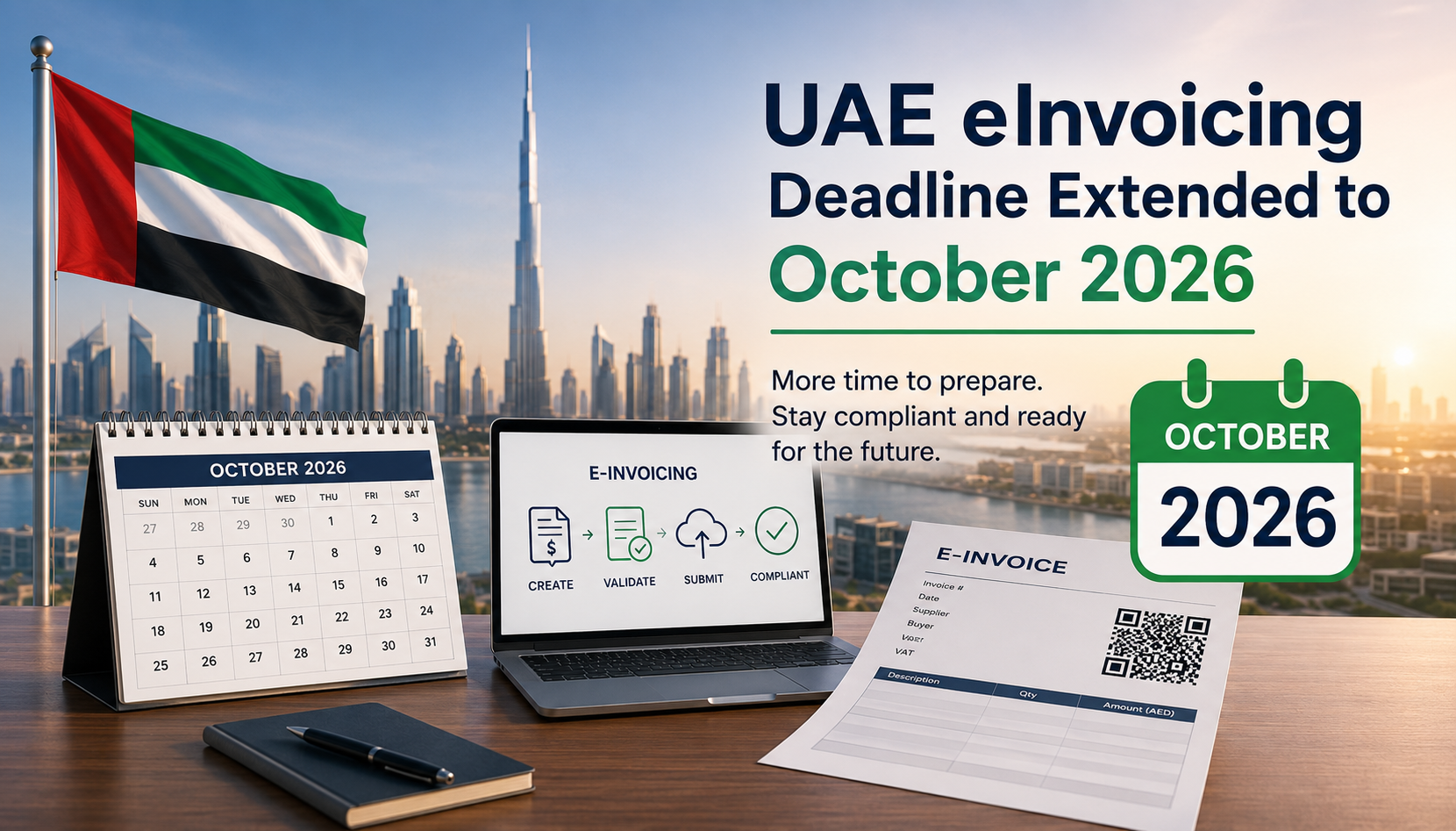
The UAE has officially slowed the clock on one of the biggest compliance transitions of 2026.
The Ministry of Finance has announced a targeted amendment to the UAE’s eInvoicing framework, extending the deadline for appointing an Accredited Service Provider (ASP) from:
31 July 2026 → 30 October 2026
But this is not a “delay” in the traditional sense.
It is a signal.
The government understands that large businesses are struggling with integration, ERP mapping, invoice standardization, and real-time reporting readiness.
And now, companies with annual revenues exceeding AED 50 million have been given a final window to prepare properly before enforcement intensifies.
What Actually Changed?
The extension was introduced through amendments to:
Ministerial Decision No. 244 of 2025
The updated rule applies specifically to:
-
Businesses subject to the UAE eInvoicing system
-
Companies generating more than AED 50 million in annual revenue
These businesses now have until:
30 October 2026
to appoint an officially approved Accredited Service Provider (ASP).
If your business crosses the AED 50M threshold, this extension is not extra time to delay.
It is extra time to prepare correctly.
Book an eInvoicing Readiness Review
Why This Matters More Than Most Founders Realize
Many businesses still think eInvoicing is simply:
“sending invoices digitally.”
It is not.
The 2026 UAE eInvoicing system is a live compliance infrastructure that connects:
-
Tax reporting
-
VAT monitoring
-
Corporate tax records
-
Banking verification
-
Transaction authentication
Once fully active, authorities will be able to cross-reference invoice data against VAT returns and corporate tax submissions almost instantly.
That means:
-
mismatched invoices,
-
inconsistent revenue declarations,
-
duplicate transactions,
-
and suspicious expense patterns
become far easier to identify.
What Is an Accredited Service Provider (ASP)?
An ASP is a government-approved technology provider authorized to integrate your business into the UAE eInvoicing ecosystem.
Their role includes:
-
Invoice validation
-
Real-time transmission
-
Digital formatting compliance
-
Secure invoice storage
-
Integration with accounting/ERP systems
Typical ASP Integration Areas
|
Business Function |
EInvoicing Impact |
|
ERP Systems |
Real-time invoice synchronization |
|
VAT Filing |
Automated reporting consistency |
|
Accounts Receivable |
Invoice authentication |
|
Corporate Tax |
Revenue reconciliation |
|
Banking Compliance |
Transaction traceability |
Book a Consultation with Evolve Tax
The companies that prepare early will automate compliance.
The companies that wait until Q4 will scramble under pressure.
Speak With Our UAE Compliance Team
The Hidden Risk: “Partial Readiness”
This is where most mid-sized and large businesses fail.
They assume:
-
having accounting software,
-
issuing PDFs,
-
or using cloud invoicing
means they are compliant.
It does not.
The UAE’s eInvoicing architecture is designed around:
-
standardized formats,
-
machine-readable data,
-
authenticated exchange protocols,
-
and regulatory interoperability.
In other words:
Your invoices must be readable by systems, not just humans.
The 2026 Compliance Pressure Is Bigger Than VAT
The UAE’s digital tax environment is becoming deeply interconnected.
The eInvoicing rollout now sits alongside:
-
Corporate Tax enforcement
-
EmaraTax integration
-
AML transaction monitoring
-
Economic Substance compliance
-
Transfer Pricing reviews
This means your invoicing behavior is no longer isolated.
It contributes to your entire compliance profile.
Which Businesses Are Most Exposed?
The highest-risk businesses heading into the October deadline include:
1. Multi-Entity Groups
Especially those operating:
-
Free Zone + Mainland structures
-
Sister companies
-
Intercompany billing systems
2. High-Volume Service Businesses
Agencies, consultancies, logistics firms, and trading companies with fragmented invoicing systems.
3. ERP-Heavy Enterprises
Businesses using:
-
SAP
-
Oracle
-
Microsoft Dynamics
-
custom ERP infrastructure
Integration delays are common.
UAE eInvoicing Timeline (2026–2027)
|
Phase |
Requirement |
Deadline |
|
1 |
Pilot & voluntary adoption begins |
1 July 2026 |
|
2 |
ASP appointment deadline for AED 50M+ businesses |
30 October 2026 |
|
3 |
Mandatory eInvoicing go-live for Wave 1 |
1 January 2027 |
|
4 |
Wave 2 implementation for smaller businesses |
Expected 2027 |
Frequently Asked Questions (FAQs)
1. Who does the new deadline apply to?
Businesses subject to the UAE eInvoicing system with annual revenues exceeding AED 50 million.
2. What is the new ASP appointment deadline?
The deadline has been extended to 30 October 2026.
3. What is an Accredited Service Provider (ASP)?
An ASP is a government-approved provider that connects your business to the UAE eInvoicing system.
4. Does this mean eInvoicing is delayed entirely?
No. The extension only applies to the ASP appointment deadline for qualifying businesses.
5. Will small businesses also be included later?
Yes. The UAE is expected to gradually expand eInvoicing requirements across additional business categories.
6. Can Free Zone companies be affected?
Yes. If they fall within the qualifying revenue threshold and scope requirements.
Conclusion: The 90-Day Extension Is a Preparation Window — Not a Delay
The extension to October 2026 is not a pause in enforcement.
It is a preparation window.
The UAE is building one of the most advanced digital tax ecosystems in the region, and eInvoicing is becoming the backbone of how authorities verify revenue, VAT, and transaction legitimacy in real time.
For businesses above AED 50 million in annual revenue, the question is no longer whether compliance is coming.
It is whether your systems, finance team, and reporting structure will be ready when it fully arrives.
Because in 2026, tax compliance is no longer reactive.
It is infrastructural.
The businesses that prepare early will operate smoothly.
The businesses that delay will face expensive operational pressure later.
Book an eInvoicing Compliance Consultation