 Emergency Call
 Monday to Friday - 08:00 - 20:00


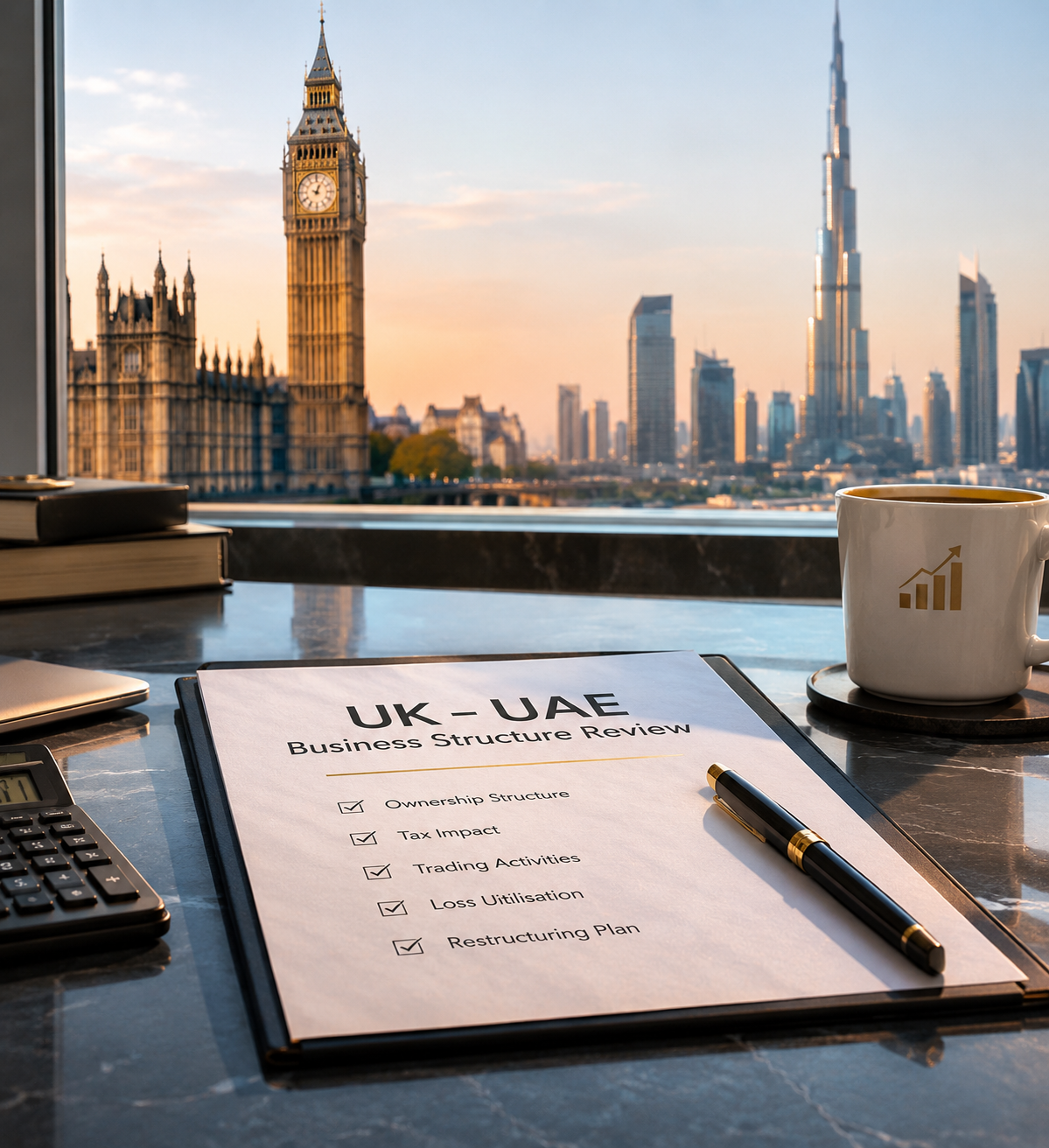
UK Company Losses After a Change of Ownership: What Happens?
Your UK company has built up £1 million of carried-forward trading losses.
Now a new investor is coming in, the company is being sold, or you're restructuring the group as part of a UK–UAE expansion.
You may think those losses simply stay with the company.
But a change in ownership can affect how certain carried-forward losses are used, particularly where the company's trade also changes significantly.
The UK has specific loss-buying rules designed to prevent companies being acquired primarily to access their tax losses. GOV.UK
So before changing ownership, you need to look at more than the company's loss balance.
You need to look at what happens to the business afterwards.
Can a Change of Ownership Restrict UK Tax Losses?
Potentially, yes.
The rules in CTA 2010 Part 14 can restrict the use of certain carried-forward losses where there is a change in ownership together with a major change in the nature or conduct of the trade. There are also rules where the company's trading activities have become small or negligible when ownership changes. GOV.UK
For post-2017 cases, the major-change test can look across a period beginning up to three years before the ownership change and extending up to five years afterwards. GOV.UK
That means the review should not be limited to what happens on the day the shares change hands.
What Counts as a Change in Ownership?
The rules contain detailed definitions, but broadly the loss-buying provisions can apply where there is a significant change in the ownership of the company.
The analysis can also extend through group structures and indirect ownership.
For example, HMRC has specific rules dealing with changes in the ownership of parent companies and how those changes can affect subsidiaries. GOV.UK
So if you are:
UK Company → new investor
or
UK Company → new UAE HoldCo structure
you need to map the ownership before and after the restructure.
Don't assume that because the UK company's legal name and operations remain the same, its ownership position is irrelevant.
What Is a “Major Change” in the Trade?
This is often the more important question.
HMRC's guidance says a major change can include:
-
a major change in the services or facilities provided;
-
a major change in customers, outlets or markets;
-
a major change in the type of property dealt with;
-
a major change in the scale of the business;
-
starting or stopping a particular trade; or
-
another major change in the nature or conduct of the business. GOV.UK
It does not mean every normal business change will trigger the rules.
Businesses naturally develop.
The question is whether the change is significant enough to fall within the statutory test.
HMRC's guidance also recognises that a major change can develop gradually rather than happening on one particular day. GOV.UK
What If You're Moving Part of the Business to the UAE?
This is where the issue can become relevant to a UK–UAE restructuring.
Suppose your UK company has:
£1 million of carried-forward trading losses.
You then change ownership and restructure the business.
Some UK activities are moved to a UAE company.
New customers are targeted.
New services are introduced.
The UK company's role becomes substantially different.
The question is not simply:
“Did we move something to Dubai?”
It is:
“Has the nature or conduct of the UK company's trade changed in a way that falls within the loss-buying rules?”
The UAE itself does not automatically trigger the restriction.
The ownership change, business changes and timing need to be considered together.
Do You Automatically Lose the £1 Million?
This is where the rules need to be understood carefully.
It is not correct to say that every change of ownership automatically wipes out every carried-forward loss.
Where the relevant conditions under CTA 2010 section 673 are met, restrictions can apply to the use of pre-change losses. The detailed effect depends on the type of loss and the circumstances of the company. GOV.UK
There are also separate rules dealing with losses after an acquisition where a major change in the business means certain post-acquisition profits cannot be sheltered by pre-acquisition losses.
HMRC explains that, under the post-2017 rules, the restriction can apply to profits related to the major change during the relevant five-year period. GOV.UK
So the right question is not:
“Are the £1m losses still on the tax computation?”
It is:
“Which profits can those losses actually be used against after the transaction?”
That distinction can materially change the value of the losses.
A Simple Example
Imagine a UK company has:
£1m carried-forward trading losses
A new owner acquires the company.
After the acquisition, the company substantially changes its business and begins a new activity that is materially different from the previous trade.
If the statutory conditions are met, the pre-change losses can be restricted from being used against profits arising from the affected activity during the relevant period. GOV.UK
So when assessing the acquisition or restructuring, you cannot simply treat the £1m as a guaranteed tax saving.
Its usability needs to be tested.
What Should You Check Before Changing Ownership?
If a UK company has significant carried-forward losses, review these before completing the transaction:
1. Ownership
Who owns the company now, and who will own it afterwards?
2. Existing trade
What does the company actually do today?
3. Proposed trade
What will change after the transaction?
4. Customers and markets
Are the customer base, markets or outlets changing significantly?
5. Services
Will the company provide materially different services?
6. Timing
When does the ownership change happen compared with the business changes?
7. Group structure
Are any parent companies, subsidiaries or related companies changing?
8. Loss position
What type of losses exist, when did they arise and what restrictions could apply?
This is particularly important where a restructure involves transferring activities between UK and UAE companies.
Don't Value £1 Million of Losses at Face Value
Carried-forward tax losses can be valuable.
But £1 million of losses does not automatically mean £1 million of future tax savings.
If ownership is changing, the next question should be:
What happens to the trade?
And if the business is also changing:
How significant is that change, and when does it happen?
The UK loss-buying rules are designed specifically to stop acquired companies' losses being used in circumstances that fall within the statutory restrictions. GOV.UK
For a UK–UAE restructuring, those questions should be answered before the ownership or business changes are implemented.
How Evolve Tax Can Help
If your UK company has significant carried-forward losses and you are considering a sale, new investment or UK–UAE restructuring, the loss position should be reviewed alongside the proposed transaction.
Evolve Tax helps UK businesses assess tax losses, ownership changes and cross-border restructuring implications before implementation.
Speak to Evolve Tax before changing the ownership or moving part of the trade.
Frequently Asked Questions
1. Can a change of ownership affect UK company tax losses?
Yes. Specific UK loss-buying rules can restrict the use of carried-forward losses where the statutory conditions are met. GOV.UK
2. Does every change of ownership restrict losses?
No. The rules apply in specific circumstances, including certain combinations of ownership changes and major changes in the nature or conduct of the business. GOV.UK
3. Does moving business activity to the UAE automatically affect UK losses?
No. The fact that activity moves to the UAE does not by itself determine the outcome. The ownership, nature of the UK trade, scale of the changes and timing all need to be considered.
4. How long can HMRC's loss-buying rules look at business changes?
For the relevant post-2017 rules, the major-change test can cover a period beginning up to three years before the ownership change and extending up to five years afterwards. GOV.UK
Conclusion
If your UK company has £1 million of carried-forward losses, don't assume they will automatically be available after a change of ownership.
The key questions are:
- Who owns the company?
- What happens to the trade?
- Is there a major change?
- When do the changes happen?
For a UK–UAE restructuring, reviewing those points before implementation can help you understand whether the company's tax losses remain usable and where restrictions may apply.