 Emergency Call
  Monday to Friday - 08:00 - 20:00


The Biggest Shift Founders Still Haven’t Fully Understood
For years, Free Zones were treated as a simple equation:
Set up a company → get 0% tax → scale freely.
That model no longer exists.
In 2026, 0% corporate tax in UAE Free Zones is not tied to your licence. It is tied to your behaviour, structure, and compliance posture as a Qualifying Free Zone Person (QFZP).
And if you get it wrong, the consequence is not just a tax adjustment.
It can be a full reclassification into the 9% regime with multi-year lockout effects.
Validate Your Free Zone Setup
At Evolve Tax, we review whether your Free Zone structure genuinely qualifies for QFZP status or whether you are exposed to silent denial risk.
Because most failures only surface during audit.
0% Tax Is Now a Conditional Status
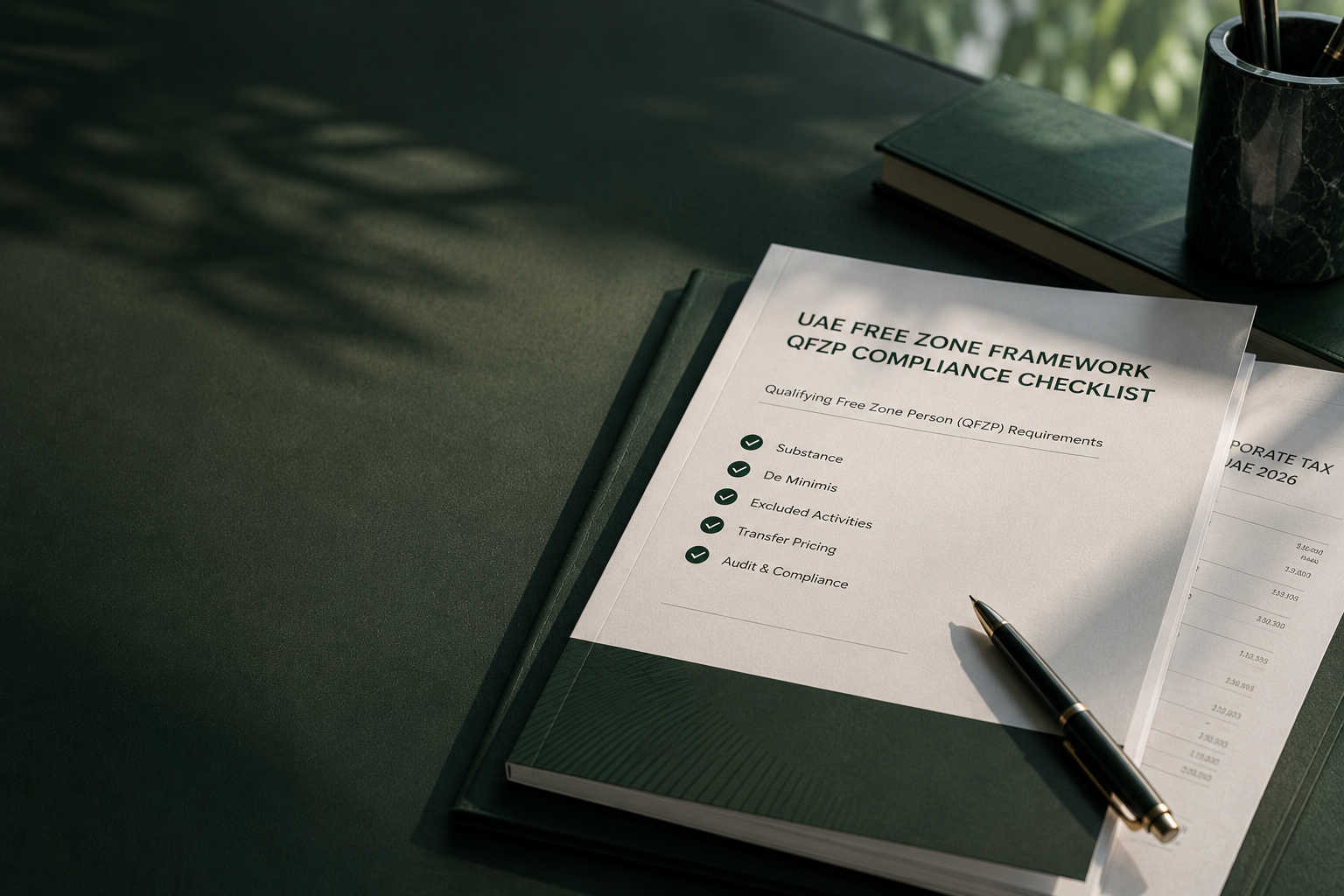
To access 0% corporate tax, your business must continuously meet:
-
QFZP qualification rules
-
substance requirements
-
de minimis thresholds
-
excluded activity restrictions
-
transfer pricing compliance
-
annual audit obligations
Miss any one of these, and your status can be withdrawn.
Not temporarily, but structurally.
The “Mailbox Company” Problem (Substance Failure)
One of the most common reasons for denial is lack of real operational substance.
In 2026, the FTA expects:
-
a physical office (not flexi-desk reliance)
-
UAE-based employees
-
real decision-making inside the UAE
-
core income-generating activity (CIGA) performed locally
If your structure looks like:
-
strategic decisions made in London
-
invoicing handled elsewhere
-
UAE office used only for registration
Then your 0% claim becomes vulnerable.
Substance is no longer a suggestion. It is a test.
Stress-Test Your Substance Position
At Evolve Tax, we assess whether your operational footprint supports your tax position, or exposes it to reclassification under substance rules.
Because structure without substance does not survive audit.
The De Minimis Cliff Edge (Where Most Mistakes Happen)
Free Zones allow limited non-qualifying income under the de minimis rule.
But this is where founders often fail.
The rule:
Non-qualifying income must not exceed the lower of:
-
5% of total revenue, or
-
AED 5 million
The risk:
Even a small miscalculation like 5.1% instead of 5% can trigger:
-
loss of QFZP status
-
full-year reclassification
-
and multi-year tax consequences
This is not a flexible threshold.
It is a cliff edge.
Check Your Revenue Exposure Before It’s Audited
At Evolve Tax, we map your revenue streams to identify whether you are close to breaching de minimis limits before the FTA does.
Because retrospective fixes are expensive.
The Five-Year Lockout Risk Most Founders Don’t Expect
One of the harshest outcomes of QFZP failure is duration.
If your status is denied due to:
-
substance failure
-
de minimis breach
-
audit failure
-
or transfer pricing violations
You may be restricted from reclaiming 0% status for up to five years.
That means:
-
long-term exposure to 9% tax
-
compounding financial impact
-
and reduced structuring flexibility
This is why classification is not just annual, it is strategic.
Excluded Activities: The Silent Tax Trigger
Certain income streams automatically create risk for QFZP qualification:
-
banking and insurance activities
-
regulated financial services
-
improperly structured IP income
-
passive royalty extraction without substance
-
certain mainland-facing transactions
Even small exposure can affect classification if not isolated properly.
Identify Hidden Excluded Activity Risk
At Evolve Tax, we review whether your revenue includes hidden excluded activity exposure that could undermine your Free Zone status.
Because classification depends on structure, not intention.
Small Business Relief Confusion (A Common 2026 Mistake)
Some founders attempt to combine:
-
Free Zone QFZP status
-
and Small Business Relief (SBR)
This is not allowed simultaneously.
Choosing SBR may:
-
simplify tax temporarily
-
but lock you out of QFZP benefits
-
and weaken long-term structuring options
Short-term relief can create long-term limitations.
The Real Audit Shift: From Paper to Proof
In 2026, audits are no longer based on declarations alone.
The FTA now evaluates:
-
office leases
-
employee records
-
banking activity
-
contract origin
-
decision-making location
-
and financial consistency
If your structure cannot be evidenced, it does not exist for tax purposes.
Frequently Asked Questions (FAQs)
1. Is 0% tax guaranteed in UAE Free Zones?
No. It is conditional on QFZP compliance every tax year.
2. What causes Free Zone tax denial?
Common causes include substance failure, de minimis breaches, and excluded activities.
3. What is substance in UAE tax law?
It refers to real operational presence, including office, staff, and decision-making in the UAE.
4. What happens if I lose QFZP status?
Your income can be taxed at 9%, potentially with multi-year restrictions on requalification.
5. Can a virtual office qualify for 0% tax?
Generally no. Physical substance is required for QFZP classification.
6. Does losing QFZP status affect past years?
It depends on audit findings, but adjustments can apply retrospectively.
7. Can I appeal a denial?
Yes, but only with strong contemporaneous evidence (contracts, records, audits).
Conclusion
Free Zone taxation in the UAE is no longer a passive benefit.
It is an active compliance status that must be defended every year.
In 2026, the difference between 0% and 9% tax is not your licence.
It is your substance, your structure, and your ability to prove both under audit.
If your setup is real, it is protected.
If it is only documented, it is exposed.
Validate Your Setup
At Evolve Tax, we help founders validate whether their Free Zone structure meets QFZP requirements and identify risks before they trigger reclassification.
We review:
-
QFZP eligibility
-
substance and operational footprint
-
de minimis exposure
-
excluded activity risk
-
audit readiness
Book a Confidential Consultation
Protect your 0% tax status before it is challenged, not after it is denied.