 Emergency Call
  Monday to Friday - 08:00 - 20:00


One Licence Is No Longer the Most Efficient Setup
In earlier UAE tax planning, a single licence was the default.
Simple structure. Simple reporting. Simple tax outcome.
That simplicity is now a liability.
In 2026, founders are increasingly discovering that a single licence structure can unintentionally increase tax exposure, especially when revenue streams are mixed across mainland and international activity.
The response has been a shift toward multi-licence strategies but with far more scrutiny than before.
Because the Federal Tax Authority (FTA) is no longer looking at entities in isolation.
It is looking at how the business actually operates.
Design a Multi-Licence Strategy That Holds Under Audit
At Evolve Tax, we help founders design multi-licence structures that separate revenue streams properly, protect Free Zone status, and avoid artificial separation risk.
Because structure only works if it is defensible.
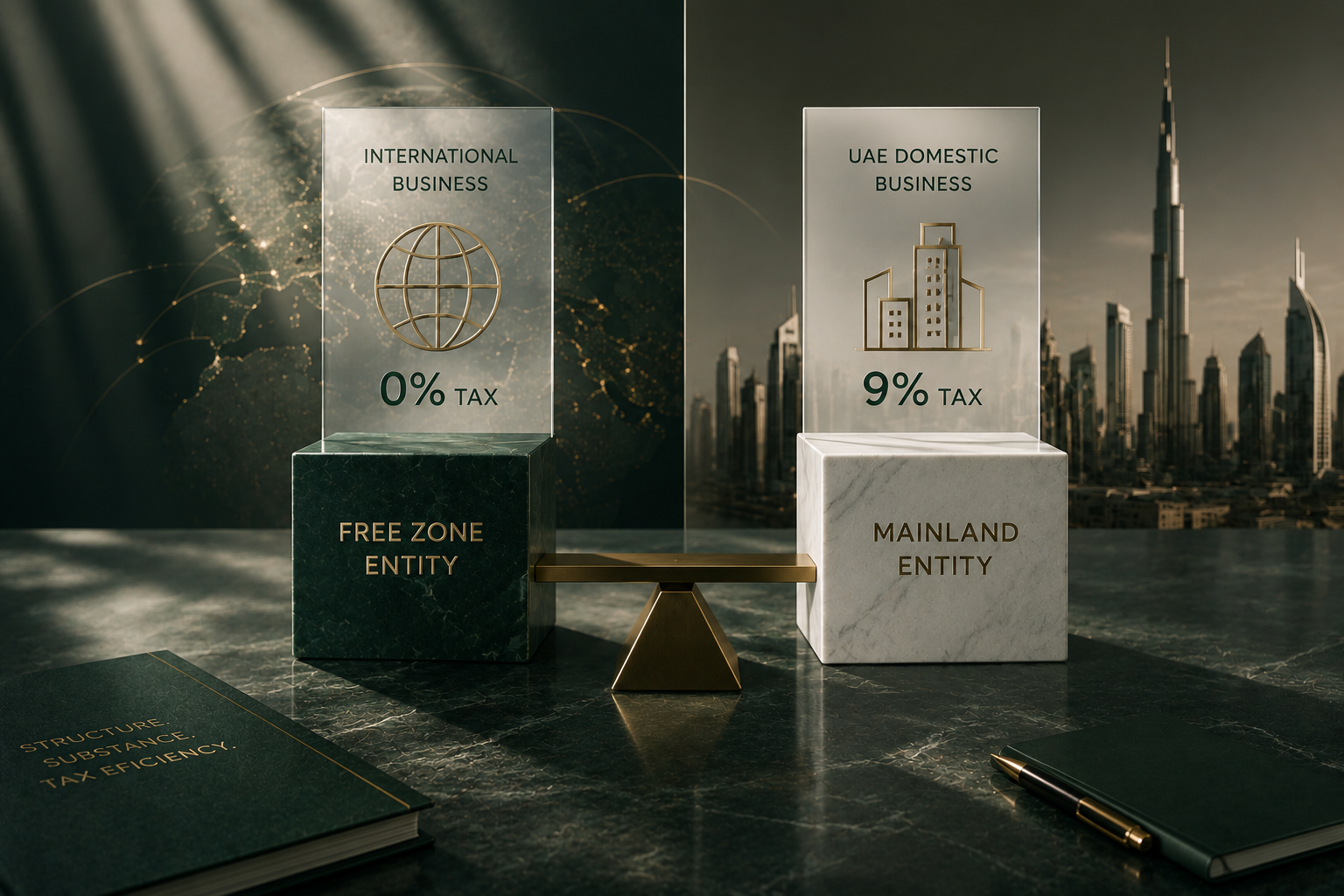
The Core Idea: The “Two-Entity” Model
The most common modern structure is:
1. Free Zone Entity
-
international clients
-
qualifying income
-
0% tax (if conditions are met)
2. Mainland Entity
-
UAE domestic business
-
local contracts
-
9% corporate tax exposure
The goal is simple:
Separate taxable exposure from tax-efficient income.
But execution is where most founders fail.
The Problem: Revenue Contamination
A single licence structure often causes:
-
mainland income mixing with Free Zone income
-
accidental breach of the de minimis threshold
-
or loss of QFZP status
Even small mainland contracts can “poison” the entire structure if not isolated properly.
That is where multi-licence structuring becomes relevant.
Check Whether Your Revenue Is Properly Separated
At Evolve Tax, we review whether your mainland and international income streams are correctly segmented or whether your structure is exposing your entire business to unnecessary 9% taxation.
Because leakage is usually invisible until it is audited.
The De Minimis Pressure Point
Under UAE Corporate Tax rules, Free Zone entities can maintain 0% status only if non-qualifying income stays within strict limits.
Once breached, consequences can include:
-
loss of QFZP status
-
taxation at 9%
-
and multi-year reclassification risk
This is why founders use a mainland entity to isolate local income instead of mixing everything in one structure.
The SBR Lifeboat (And Why It Is Closing)
Small Business Relief (SBR) has been a temporary cushion for SMEs under AED 3M revenue.
But there is a key shift:
The relief is currently expected to end on 31 December 2026.
This has created a temporary strategy window where founders split business lines across licences to stay under thresholds.
However, this only works if the separation is real.
Not artificial.
Plan Before Relief Conditions Change
At Evolve Tax, we help founders model whether their current structure benefits from SBR today and what happens when it disappears in 2027 planning cycles.
Because timing matters as much as structure.
The Biggest Risk: Artificial Separation
The FTA actively challenges structures that exist only to reduce tax.
Under General Anti-Abuse Rules (GAAR), they look for economic reality, not paperwork.
Red flags include:
-
shared staff across entities without allocation logic
-
identical ownership with no operational separation
-
intercompany transfers without commercial basis
-
duplicated but inactive business licences
If separation is artificial, the structure is ignored for tax purposes.
What Real Separation Looks Like
A defensible multi-licence structure requires:
-
distinct business activities per entity
-
separate bank accounts
-
independent financial records
-
formal intercompany agreements
-
and clear operational roles
If entities behave like one business, they will be treated as one.
Stress-Test Your Multi-Licence Structure
At Evolve Tax, we assess whether your structure demonstrates genuine operational separation or whether it is vulnerable to GAAR-based reclassification.
Because intent does not override evidence.
Mainland vs Free Zone: The Real Trade-Off
A properly structured dual setup often looks like this:
-
Free Zone: international revenue at 0% (if QFZP conditions are met)
-
Mainland: UAE revenue taxed at 9%
The benefit is isolation of tax triggers.
The risk is misclassification if revenue flows are not clearly defined.
The Hidden Rule: Intercompany Pricing Still Applies
Even with two licences, you cannot freely move profit.
All transactions between entities must follow:
-
arm’s length pricing
-
transfer pricing documentation
-
and commercial justification
Otherwise, profit shifting will be reversed in an audit.
Align Your Internal Cross-Entity Pricing
At Evolve Tax, we ensure intercompany pricing between Free Zone and Mainland entities is defensible under UAE Corporate Tax rules.
Because structure without pricing discipline fails under review.
When Multi-Licence Strategies Work Best
This approach is most effective when:
-
business lines are genuinely different
-
revenue sources can be clearly separated
-
and operational substance exists in both entities
Examples include:
-
consulting + e-commerce separation
-
international services + UAE contracting
-
product business + holding structure
Frequently Asked Questions (FAQs)
1. Can I use multiple licences in the UAE?
Yes, but each licence must have a clear and distinct business purpose.
2. Does a multi-licence setup reduce tax automatically?
No. It only works if revenue and operations are properly separated.
3. What is artificial separation?
A structure created only to reduce tax without real operational independence.
4. Can Free Zone and Mainland companies share staff?
Yes, but costs must be allocated and documented through intercompany agreements.
5. What is the SBR limit in the UAE?
AED 3 million revenue threshold (subject to sunset conditions after 2026).
6. Can the FTA combine my businesses?
Yes, if they determine the entities are not genuinely separate.
7. Do intercompany transactions need pricing rules?
Yes. They must follow arm’s length transfer pricing standards.
Conclusion
Multi-licence structuring is no longer about reducing tax through separation alone.
It is about building real operational segmentation that can survive regulatory scrutiny.
In 2026, the FTA is focused on substance, not structure.
If your setup looks like one business split on paper, it will be treated that way in practice.
But if your structure reflects genuine operational independence, it becomes one of the most effective ways to manage tax exposure across Free Zone and Mainland activity.
Design a Multi-Licence Strategy
At Evolve Tax, we help founders design and audit multi-licence UAE structures that separate revenue correctly, reduce unnecessary tax exposure, and withstand FTA scrutiny.
Whether you operate:
-
Free Zone companies
-
Mainland entities
-
or hybrid group structures
We ensure your setup is commercially real and tax compliant.
Speak With Our Team About:
-
multi-licence structuring
-
Free Zone vs Mainland separation
-
SBR planning and sunset impact
-
anti-abuse risk assessment
-
intercompany pricing alignment
Book a Confidential Consultation Today
Contact Evolve Tax to design a multi-licence strategy that is structured for growth and built to survive audit reality.